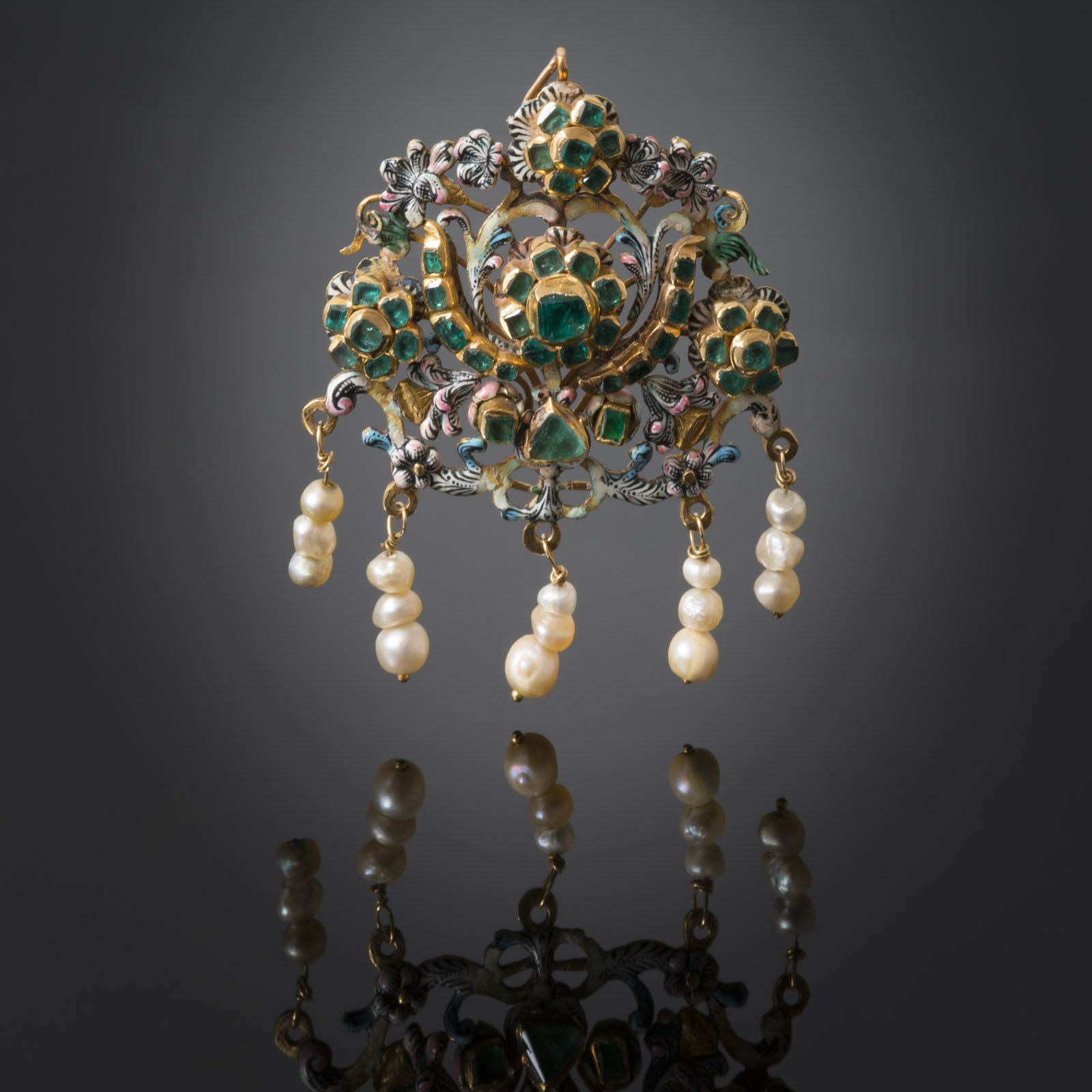
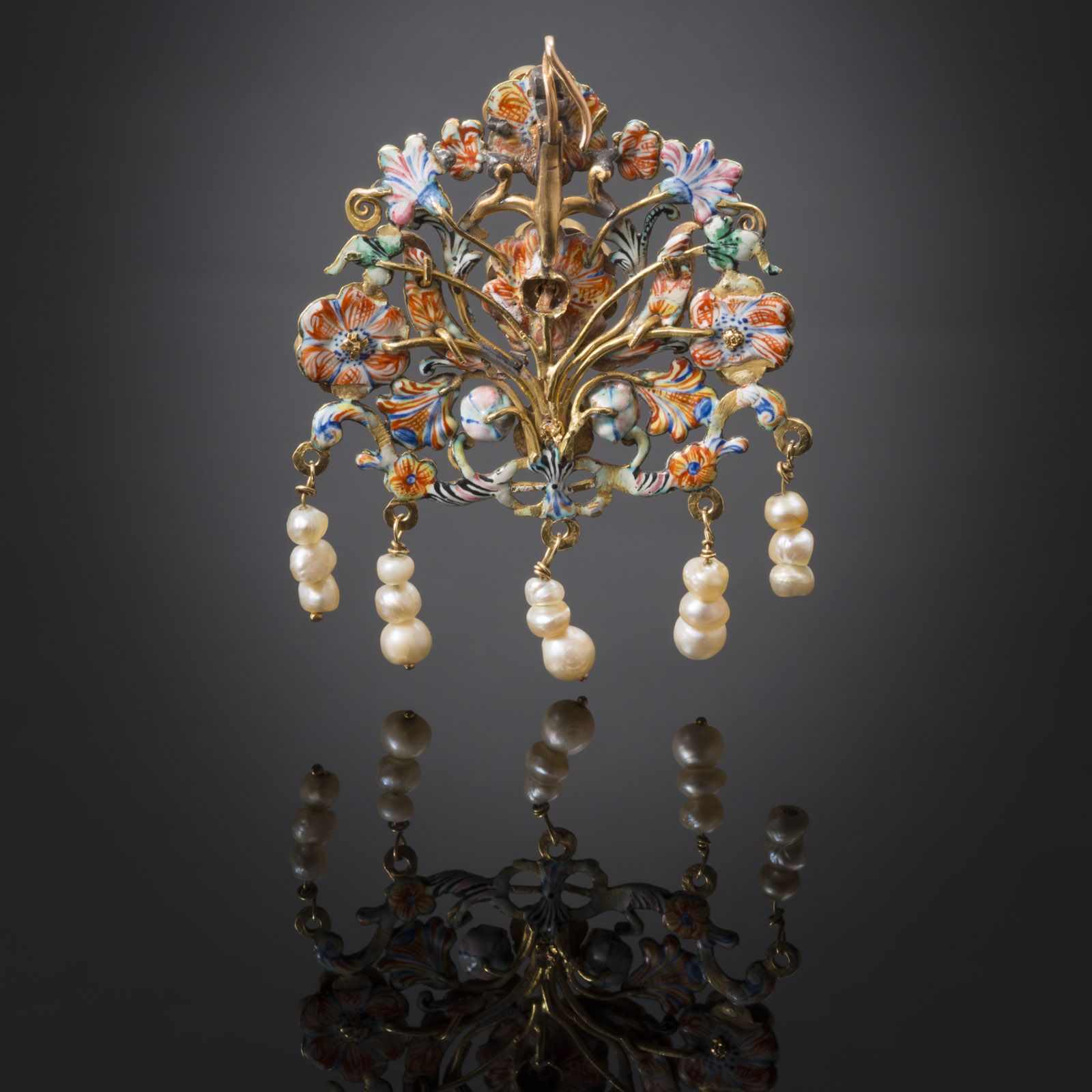
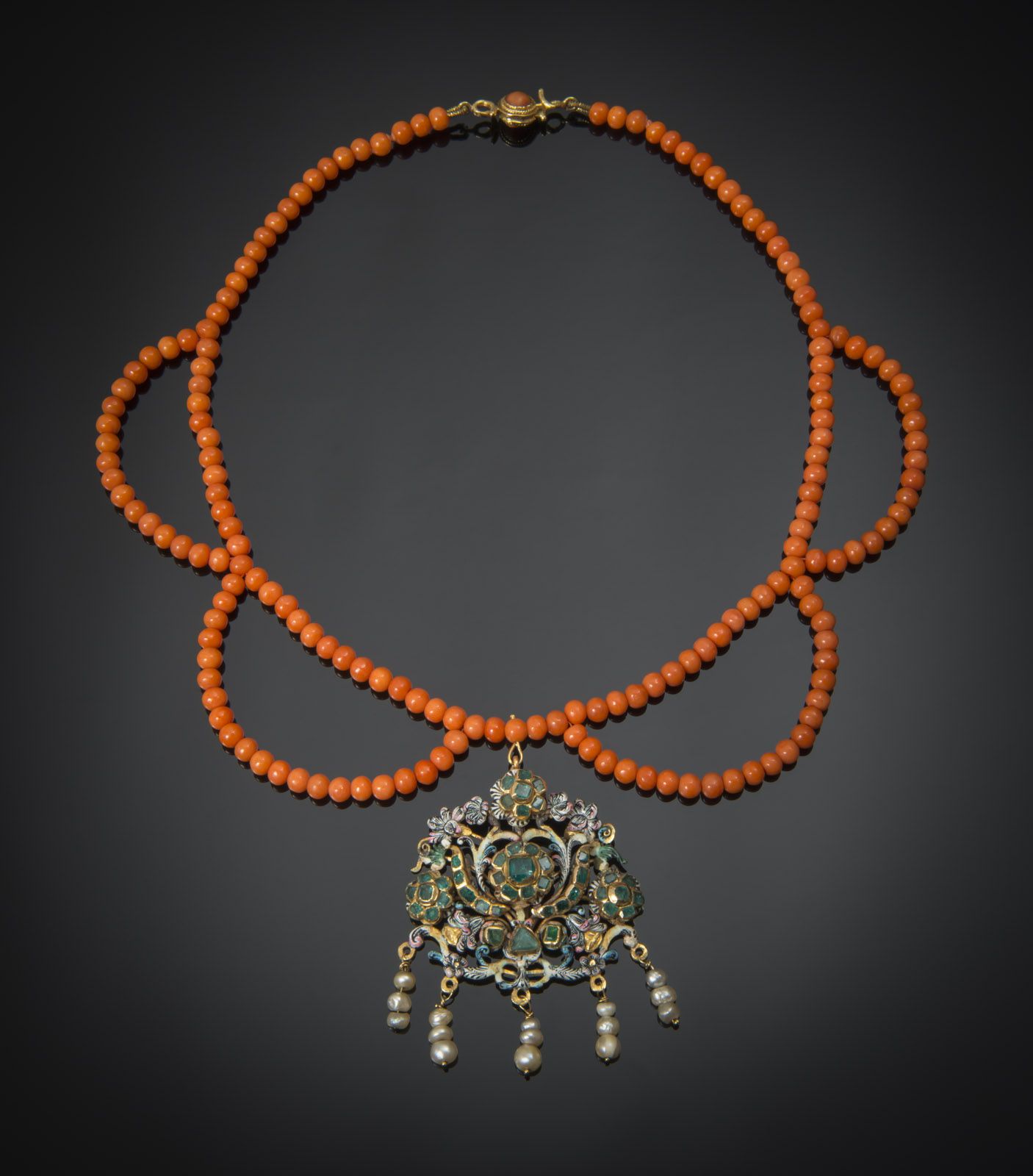
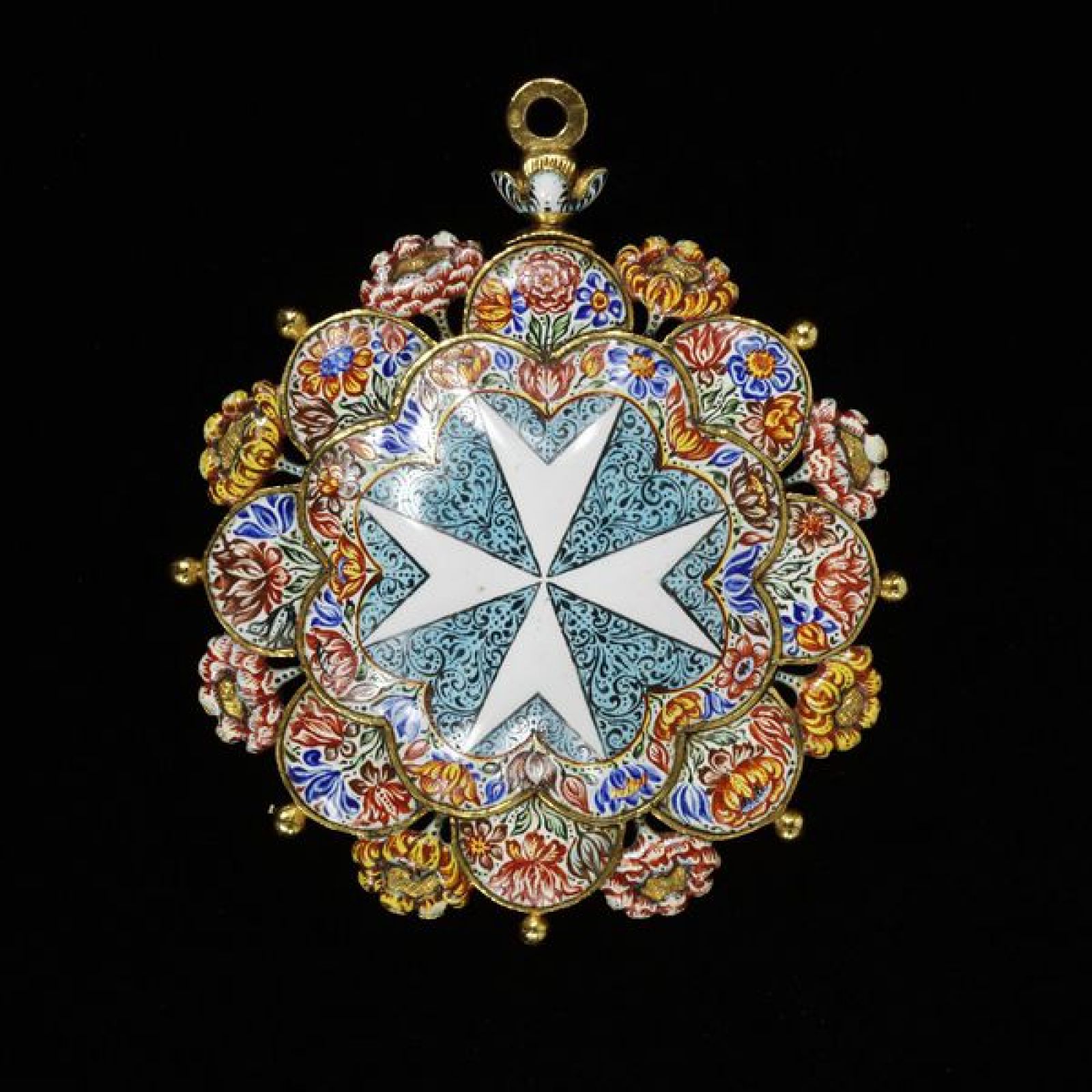

Very rare Baroque jewel in enamelled gold, set with 43 table-cut emeralds and hung with natural pearls. The front of the pendant is composed of two parts: the swirling foliate decoration around the sides and the central decoration, which holds the stones. The open design is obtained by a gold plate that has been pierced and chased. The upper flowers are soldered to gold stems and joined together at the center. Emeralds are set into close setting on round rosettes and in linear, stylised depictions of leaves. The painted enamel palette includes white, black, turquoise, blue, light fuchsia and green. The reverse reveals the stems of the soldered flowers, the mechanically fastened pins of the gemset and a wonderfully rich polychromy of enamels. In addition to the aforementioned colours, there is red, yellow and blue.
Loss of some parts of enamel as commensurate with age. The pendant loop was added later, probably in the XIXth century through soldering.
This piece of early jewellery is a very interesting example of the fashion for flowers that characterised the period between the 1640s and the 1660s. Originally a Dutch phenomenon, the infatuation for exotic flowers, especially for tulips, led to the creation of the first botanical gardens across Europe. Among these, the Parisian “Jardin Botanique”, built in 1630, was a great source of inspiration for artists and thus influenced the creation of jewellery design. Our bouquet is richly decorated with flour de lys, tulips, bluebells, roses and vine leaves.
This piece is also an extraordinary example for the richness of its colours and the vast range of techniques used in its creation.
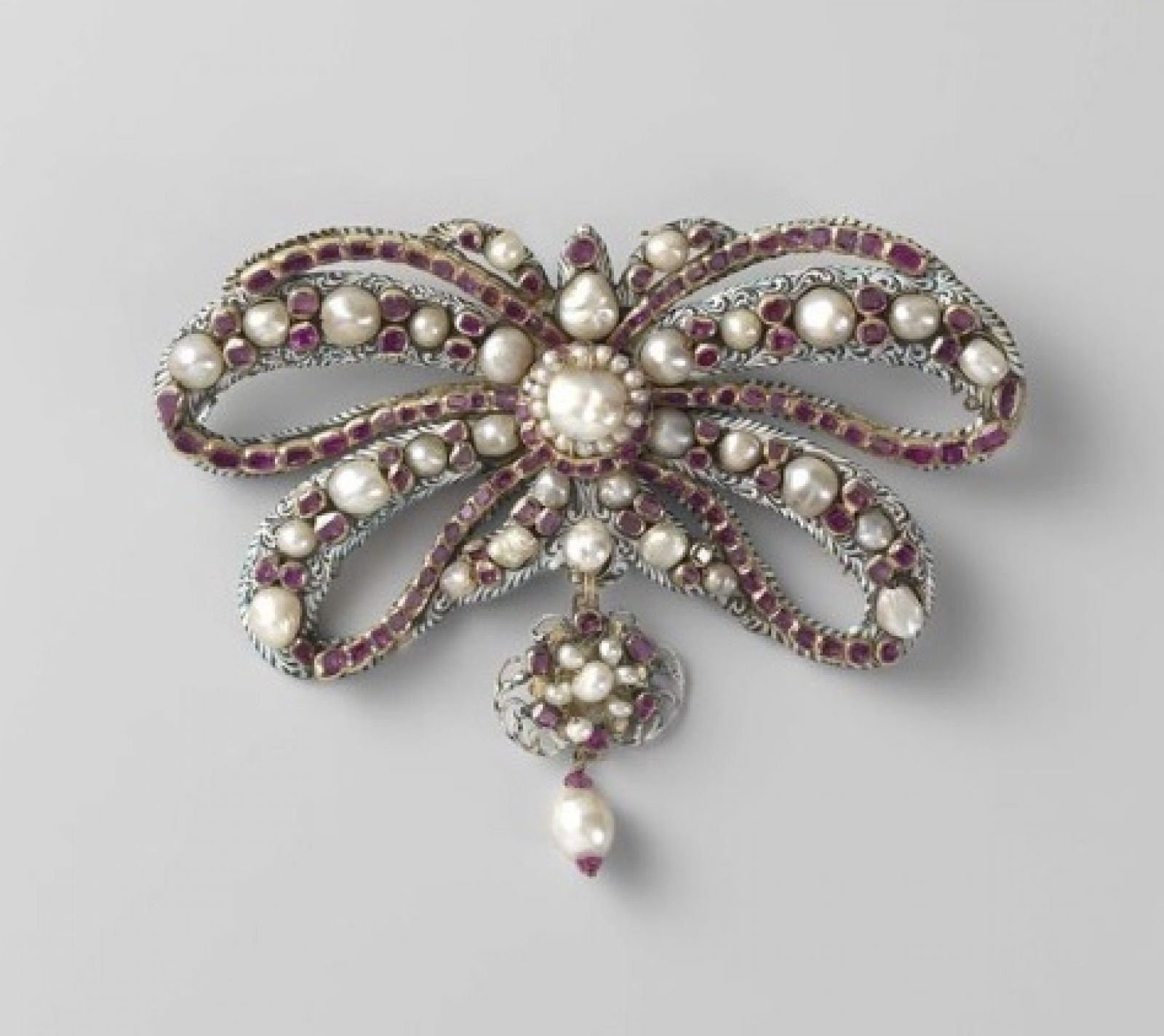
On the front, a chiaroscuro effect is given by very delicate black brushstrokes on a white background with highlights of pink and blue. This technique calls to mind the best creations now displayed in museums, like the Bow Brooch of the Rijksmuseum, Amsterdam (1, see third photo attachment). Here we can see a similar gemset mounting in linear arrangements too. The pale blue and the fuchsia are identical to those of an enameled pendant conserved in the Pepoli Museum of Trapani, Sicily (2).
On the reverse, the colours are so numerous and strong that it is a rare sight to see, and, in general, they evoke the style of Joseph Bruno, the renowned goldsmith from Messina (See fourth photo attachement).
The gold kept in reserve in the bluebell flower creates a beautiful contrast with the enamels. In the same way, the pins of the rosettes are hammered on the back, allowing them to perfectly represent the pistils of the flowers pictured in the enamel.
To conclude, while this piece can be considered a true technical tour-de-force, it is also important to consider that the majority of artefacts of that era represented religious subjects: in our case, the profane inspiration increases the attractiveness of the piece. The early époque, the richness of techniques and the rare iconography, make this piece a special gift for fine collectors.
1 Bow Brooch, ca. 1675, Rijksmuseum, cat. BK-1961-3.
2Pendant with Gold Bow, Museo Pepoli, Palermo see.: Maria Concetta di Natale, Gioielli di Sicilia, Palermo 2000, p.178.
For a exhaustive description of this time jewellery history see:
⁃ Michèle Bimbenet-Privat, Les orfèvres et l'orfèvrerie de Paris au XVII e siècle, Paris, 2002., pp. 165-174.
⁃ Maria Concetta di Natale, Gioielli di Sicilia, Palermo, 2000